Immobilizer Authorization: Why a Correctly Cut Key May Still Not Start the Vehicle
Learn how a vehicle immobilizer uses key recognition and authorization to help prevent unauthorized starting, and why a mechanically correct key may still fail to start the vehicle.
Educational visual created for AutoLocksmith.LLC. Vehicle systems vary by manufacturer, model, year, and equipment.
Overview
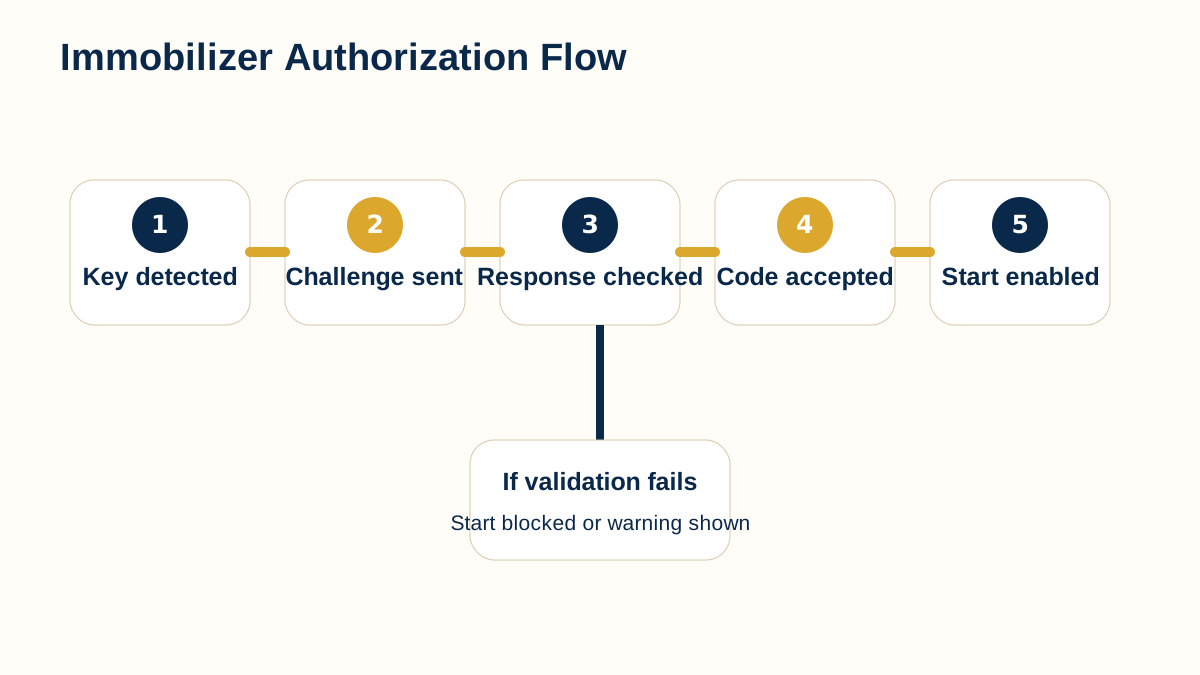
A vehicle immobilizer adds electronic authorization to the starting process. In an immobilizer-equipped vehicle, a key can be mechanically correct enough to turn a lock or ignition cylinder yet still fail to start the engine if the electronic identity is not recognized. The immobilizer’s purpose is to make possession of a copied metal blade insufficient by itself. Exact designs vary, but the general concept is consistent: identify the key, validate it, and authorize normal starting only when the expected security conditions are met.
Mechanical access and electronic authorization are different
The mechanical blade interacts with the physical lock. The immobilizer system evaluates an electronic credential associated with the key or fob. These are separate layers.
That is why key cutting alone may not create a functioning starting key on an immobilizer-equipped vehicle.
How the vehicle detects the key
Depending on the system, the vehicle may communicate with a transponder near the ignition area or with a smart key through wireless antennas and control modules. Detection only establishes that a key is present or responding.
The vehicle still needs to determine whether that response belongs to an authorized credential.
Validation and recognition
The system compares or evaluates the key’s response according to the manufacturer’s security design. The details differ and are intentionally protected, but the high-level purpose is to distinguish an authorized key from an unknown or incompatible one.
A key with the wrong electronics may fit physically while failing this stage.
Authorization to start
When the required security checks succeed, the immobilizer permits the normal starting process. If authorization fails, the vehicle may crank without starting, refuse to crank, display a security indicator, or show another manufacturer-specific symptom.
These symptoms are not universal, so diagnosis should use vehicle-specific information rather than assumptions.
What programming changes
Programming or registration establishes an approved relationship between a compatible key and the vehicle. It does not physically reshape an incorrect key, repair a damaged circuit board, or fix unrelated vehicle faults.
Programming cannot make every visually similar key compatible. The underlying hardware still has to match the vehicle application.
Why immobilizer symptoms can be confusing
A weak vehicle battery, damaged key, antenna issue, communication fault, or module problem can create symptoms that resemble an unprogrammed key. Conversely, a key can operate remote buttons while still failing starting authorization.
Separating remote convenience functions from immobilizer authorization is often important during diagnosis.
Replacement-key considerations
A proper replacement may require a compatible electronic key, correct mechanical cutting where applicable, authorized programming, and final testing. If no working key remains, the service path can differ from adding a spare key.
Vehicle and key information should be confirmed before purchasing replacement hardware.
Security and ownership
Immobilizer systems are designed to protect the vehicle. Educational material should explain the system without providing procedures intended to defeat or bypass authorization.
Legitimate key creation and programming should be performed for the owner or an authorized party with appropriate verification.
How this concept helps with troubleshooting
Understanding immobilizer authorization helps drivers avoid confusing a key-cutting problem with an electronic recognition problem. If a key will not physically turn, the concern begins with the blade, lock, or cylinder. If it turns but the vehicle reports a security problem, electronic authorization becomes more relevant. If a known-good spare works normally, that comparison provides additional evidence. These distinctions do not provide a complete diagnosis, but they help describe the symptom accurately and reduce unnecessary replacement of unrelated parts.
What the driver may see when authorization fails
Different vehicles react differently when the immobilizer does not authorize a key. Some display a security symbol, some show a key-related message, some crank without normal starting, and others prevent the starting sequence earlier. Because those behaviors vary, the warning indicator and exact symptom should be recorded rather than interpreted from memory.
A driver should also compare a known-good spare key if available. If the spare works, the original key or its authorization becomes more suspect. If neither key works, vehicle power, antennas, control modules, or other vehicle-side conditions may need consideration.
Why security-system work requires careful verification
Creating or registering an automotive key changes who can use a protected vehicle. For that reason, responsible service includes verifying that the person requesting the work owns the vehicle or has authorization to act for the owner. This is a normal part of legitimate locksmith and key-programming work, not an inconvenience added after the fact.
The same security principle is why educational explanations should remain at the conceptual level. Drivers benefit from understanding detection, validation, and authorization, while procedures designed to defeat those controls should remain outside a public educational guide.
Key takeaways
Immobilizers add electronic authorization beyond the metal key shape.
A key can fit mechanically and still be electronically unauthorized.
Programming requires a compatible key; it does not create compatibility by itself.
Remote-button operation and immobilizer authorization are separate functions.
Continue learning
Use these related AutoLocksmith.LLC resources to continue from the visual into broader driver education and technical background.
Professional automotive key help when you need it.
AutoLocksmith.LLC provides education and referral guidance. For supported mobile automotive key and vehicle-security services, contact Wood's Automotive Locksmith.
When you call, mention that you found the service through KEYRING to receive $10.00 off your bill