Fresh driver guidance and articles every day
Today in Driver Help & Articles
Choose the problem you are trying to solve.
Each guide explains the situation in plain language and points drivers toward professional help when that is the safest choice.
Volvo Key Programming
Model-specific key programming for select supported Volvo vehicles and years.
Lost Car Keys
Help when a vehicle key is missing, damaged, or no longer available.
Vehicle Lockouts
What to do when keys are locked inside a car, truck, van, or work vehicle.
Key Fob Programming
Plain-English guidance for remotes, fobs, batteries, and programming questions.
Transponder Keys
How chipped keys work and why matching the vehicle matters.
Smart Keys And Push-To-Start
Driver guidance for push-button start vehicles and proximity keys.
Ignition Problems
Common warning signs when the key will not turn or the ignition feels damaged.
vehicle key assistance
What to avoid when a key breaks in a door, trunk, or ignition.
Spare Car Keys
Why a spare key can prevent expensive roadside problems later.
Remote Key Programming
How remotes, fobs, and vehicle security systems work together.
Fleet Locksmith Help
Planning key support for work trucks, delivery vehicles, and small fleets.
Roadside Locksmith Help
Practical steps for travelers dealing with key or lock problems away from home.
RV And Camper Key Help
Helpful key and lock planning for campers, RVs, tow vehicles, and weekend trips.
Match the guide to the key system
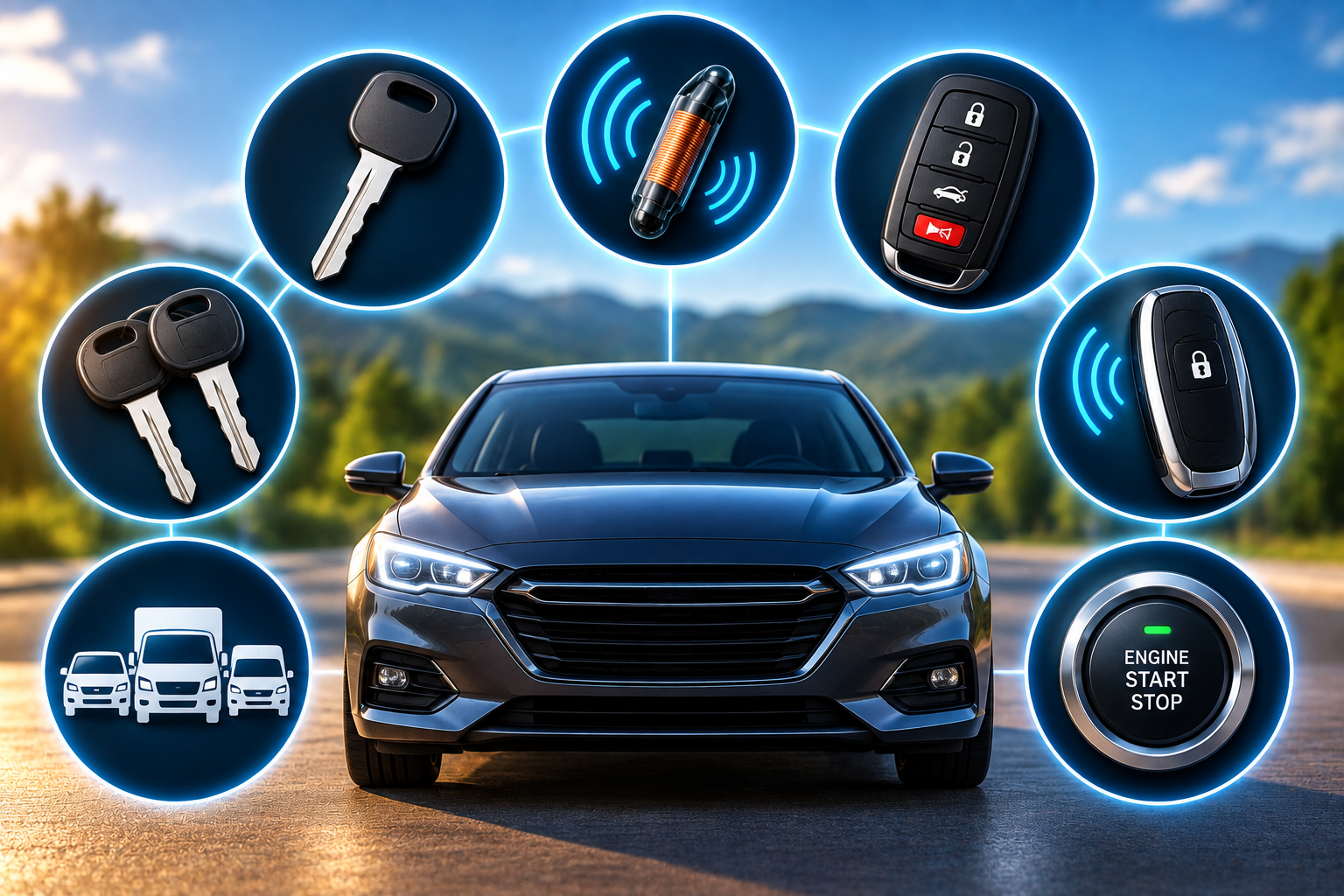
Vehicle-key services are not interchangeable. A traditional metal key, chipped transponder key, remote-head key, proximity fob, and push-button-start key can require different parts, equipment, and programming procedures.
- Replacement car keys: for a missing, damaged, or unavailable key.
- Key duplication: for creating an additional key while a working key remains.
- Transponder programming: for chipped keys that must be recognized by the immobilizer.
- Key-fob replacement and programming: for remote buttons, remote-head keys, and compatible fobs.
- Smart and proximity keys: for passive-entry and push-button-start vehicles.
- Fleet support: for organized key records, replacements, and programming across work vehicles.
Before contacting a professional, use the Before You Call checklist.
How to use these service guides
Start with the guide that most closely matches what the vehicle is doing now. Lost keys, lockouts, remote-button failures, transponder problems, smart-key recognition, spare-key planning, fleet management, roadside situations, and RV key planning involve different questions.
These pages are educational. They do not guarantee availability, compatibility, response time, or that every provider can service every vehicle.
Choosing the right starting point
A service guide is most useful when it matches the driver's actual problem. Someone who cannot enter the vehicle needs different information from someone whose remote buttons stopped working. A driver who has lost every key is in a different position from an owner who still has one working key and wants a spare. Start by describing what the vehicle does now, not by naming the repair you think it needs.
The directory is organized around those practical differences. Lost-key pages focus on replacement planning. Lockout pages focus on access. Smart-key, transponder, remote, and key-fob pages focus on electronic recognition and compatibility. Spare-key and fleet pages emphasize prevention and continuity. Roadside and RV pages add travel and multi-key planning.
Mechanical and electronic functions
Modern vehicle keys can combine several functions. A mechanical blade may open a door. A transponder may authorize starting. Remote electronics may control locks or a hatch. A smart key may support passive entry and push-button start. These layers explain why one function can work while another does not.
A useful description separates those functions instead of assuming the entire key has failed. That distinction can reduce unnecessary replacement and helps a provider identify what information or equipment may be needed.
Prevention belongs in the service section
Many stressful key situations start with a preventable gap: only one working key, an untested spare, a weak fob battery, no record of the key type, or a replacement bought without verification. Preventive planning does not eliminate every failure, but it gives the owner more options when something goes wrong.
A working spare, clear vehicle records, and a known key type can turn an emergency into a scheduled replacement or programming decision.
What to have ready
Before requesting service, gather the vehicle year, make, model, exact location, key type if known, whether any working key remains, and proof of ownership or authorization. If a replacement key or fob has already been purchased, keep the packaging and identifying information.
Do not assume a replacement is compatible merely because the shell looks right. Similar-looking products can use different electronics, chips, frequencies, or programming procedures.
Building a clear record for automotive locksmith service guides
When dealing with automotive locksmith service guides, keep a short record of what happened, when it happened, which key or fob was involved, and what changed immediately beforehand. If the issue is intermittent, record both successful and failed attempts. A timeline is often more useful than a general statement that the problem has been happening 'for a while.'
Keep original parts, labels, receipts, packaging, and identifying information until the issue is fully resolved. If a replacement has already been purchased, note where it came from and what compatibility information was provided. This can help distinguish a part-identification problem from a programming or vehicle-side problem.
After the immediate problem is resolved, review whether a preventive step would reduce future disruption. That may mean creating a tested spare, replacing a weak fob battery, separating travel keys, updating a fleet inventory, or keeping vehicle information where an authorized driver can access it. Prevention should be practical and vehicle-specific rather than based on assumptions.
How automotive locksmith service guides fits into vehicle ownership
Automotive Locksmith Service Guides is easier to manage when it is treated as part of normal vehicle ownership rather than as an isolated emergency. Owners benefit from knowing what type of key system the vehicle uses, how many working keys remain, where spare keys are stored, and which functions depend on electronics rather than the mechanical blade. That basic information can make later troubleshooting faster and can reduce the chance of buying an incompatible replacement.
Vehicle-key systems also change across model years and trim levels. A guide can explain common patterns, but the final service decision should still be tied to the specific vehicle. Keeping the owner's manual, vehicle identification information, and original key or fob identifiers available gives the owner a better foundation for those decisions.
Separating symptoms from conclusions
When reviewing automotive locksmith service guides, describe the symptom in plain language before deciding what failed. A door that will not unlock, a remote that has short range, a key that turns but does not start the vehicle, and a smart key that is not detected are different observations. Each points toward a different set of possible causes, and none by itself proves that one specific component needs replacement.
This matters because several systems can overlap. Vehicle battery condition, key-fob battery condition, physical key wear, antennas, immobilizer authorization, remote electronics, and mechanical locks can produce symptoms that owners describe with the same general phrase. A careful description protects against replacing parts simply because the symptom sounds familiar.
Replacement decisions should be evidence-based
A replacement connected with automotive locksmith service guides should be chosen only after compatibility is reasonably established. The safest sequence is to identify the vehicle, identify the original key or fob when possible, confirm what functions are required, and then verify the replacement. Cutting or programming should come after that identification step, not before it.
Keep receipts, packaging, part identifiers, and the original component until the replacement has been fully tested. If the replacement fails to perform one expected function, those records can help determine whether the problem is the part, the programming, the vehicle, or an incorrect assumption about what the vehicle supports.
After the immediate problem is resolved
Once automotive locksmith service guides is no longer urgent, take a few minutes to reduce the chance of the same disruption happening again. Test any spare key, update the key inventory, replace weak batteries when appropriate, and decide where important backups will be stored. If several people use the vehicle, make sure each authorized driver understands which key or fob is the primary one and where a backup can be found.
For travel, fleet, or family vehicles, write down the vehicle year, make, model, key type, and any useful part identifiers in a secure place. That record should not expose sensitive vehicle-security information publicly, but it can help an authorized owner describe the situation accurately when future service is needed.
A final decision check for automotive locksmith service guides
Before acting on automotive locksmith service guides, pause long enough to verify that the proposed next step actually matches the symptom. Ask what evidence supports the decision, what remains uncertain, and whether the change being considered is reversible. If a key or fob is still partially functional, document those working functions before programming, replacement, or repair changes the starting condition.
Keep the original component available whenever possible. A worn key, damaged shell, old fob, packaging label, or prior invoice can contain useful identifying information. Once the issue is resolved, write down what fixed it and which part or procedure was used. That record can save time later if a second key is needed or the same symptom appears on another vehicle in the household or fleet.
Finally, separate urgent safety concerns from routine service questions. A vehicle in a dangerous roadside position, a child or pet locked inside, or another immediate hazard may require emergency help. A routine compatibility, programming, or replacement question can usually be handled more methodically. Treating those situations differently keeps the response proportionate to the actual risk.